
IUL vs 401(k): Take the Match First, Then Compare the Rest
People ask which one is better. Wrong question. The match comes first, and after that the two accounts are not competing for the same job.
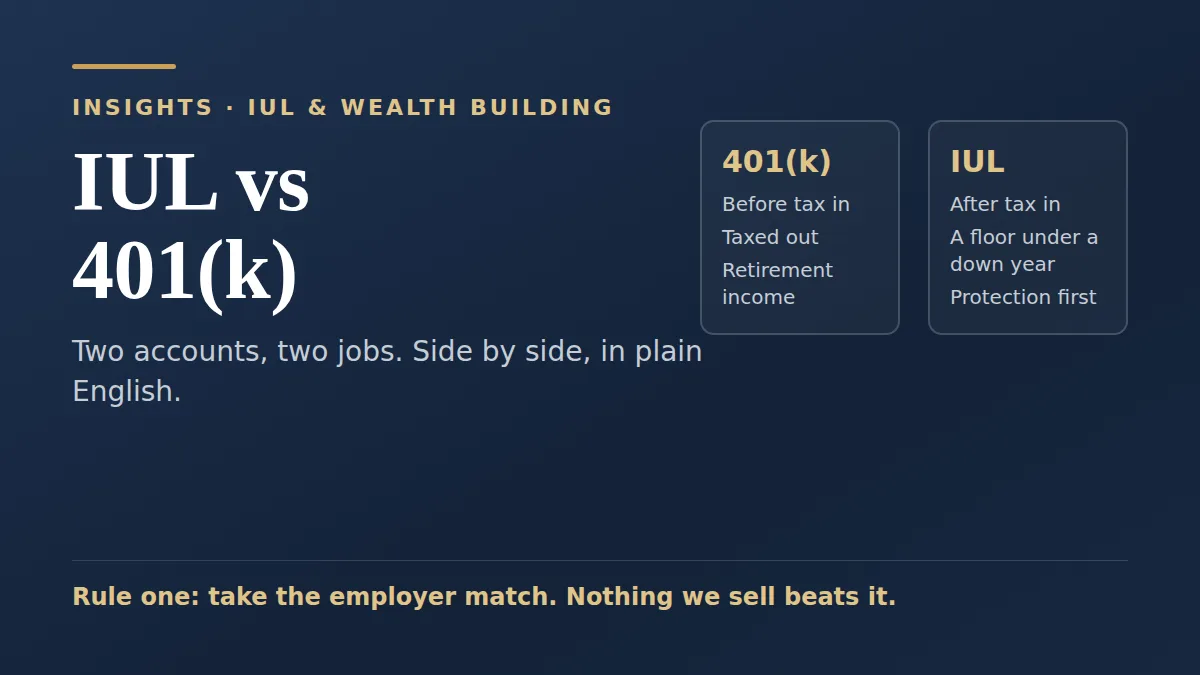
Which one is better is the wrong question. The two accounts were built for different jobs, and one rule comes before either of them.
Rule one: take the match
If your employer matches part of what you put into a 401(k), take every cent of it before you do anything else. Nothing we sell beats it. A match is an immediate return on your own money, and no index account, floor or participation rate comes close. The Blueprint says the same thing on step four, and this article does not move it.
What a 401(k) does with a dollar
A traditional 401(k) takes the dollar before tax. More of your paycheck goes to work, and the account grows without a tax bill each year. The trade comes later. Withdrawals are taxed as ordinary income. Reaching the money before 59½ carries a penalty in most cases. The IRS sets a yearly ceiling on what you can put in, and a date when distributions must start. The money is invested, so a down year is a down year, and fund fees come out along the way.
That is a good account doing the job it was built for: retirement income, with the tax paid at the end.
What an IUL does with a dollar
An indexed universal life policy takes the dollar after tax. Part of it buys a death benefit that is in force from day one. The rest goes into an account that is credited once a year on what a blend of stock indices did. On our flagship design the credit is 113% of the blend's move with no ceiling. In a down year the credit is floored at 0.75% instead of going negative. The floor is guaranteed. The participation rate is current, and the insurance company can change it.
The costs are real and heaviest early: cost of insurance, a premium load, a monthly policy charge, and a 0.72% index account charge on this design. That is why it is a five to seven years vehicle or longer, and a poor short one.
What it can do that a retirement account cannot: let you borrow against the cash value at any age without the early withdrawal penalty, carry no required distributions and no IRS contribution ceiling, and pay a death benefit to your family outside probate. Access can reach you without an income tax bill when the policy is structured properly, stays out of modified endowment status, and does not lapse with a loan outstanding.
Side by side
| 401(k) | IUL | |
|---|---|---|
| Money goes in | Before tax | After tax |
| Money comes out | Taxed as income | Withdrawals and policy loans, tax-advantaged when structured properly |
| Before 59½ | A penalty in most cases | Policy loans at any age |
| A down year | The account falls with the market | The credit is floored at 0.75%; charges still apply |
| A ceiling on what goes in | Yes, set by the IRS | Set by the policy design, not the IRS |
| Required distributions | Yes | No |
| Death benefit | The balance | From day one, outside probate |
| Costs | Fund fees | Insurance and policy charges, heaviest early |
| Built for | Retirement income | Protection first, with money you can reach, held five to seven years or longer |
Why it is not either or
The 401(k) is retirement income with the tax paid at the end. The IUL is protection first, with money you can reach along the way and a floor under a down year. Most families we work with hold both: the match first, then a policy sized to what they can fund for five to seven years without strain.
Who should not add an IUL
- You are not taking your full employer match yet.
- You have no emergency fund. Build three to six months first.
- You need the money back before the five to seven years mark.
- Your income is irregular enough that a steady premium would strain you.
- Your main need is the largest death benefit for the lowest cost. That is term, and we write term.
What we do with this
We educate, clarify and align the strategy with the goals you set, and we write the coverage that fits. A strategy session is where the numbers in your own situation get run, with your 401(k) statement and your match on the table.
How we are paid
The insurance company pays a commission when a policy is placed. The session, the illustration and the advice cost you nothing.